
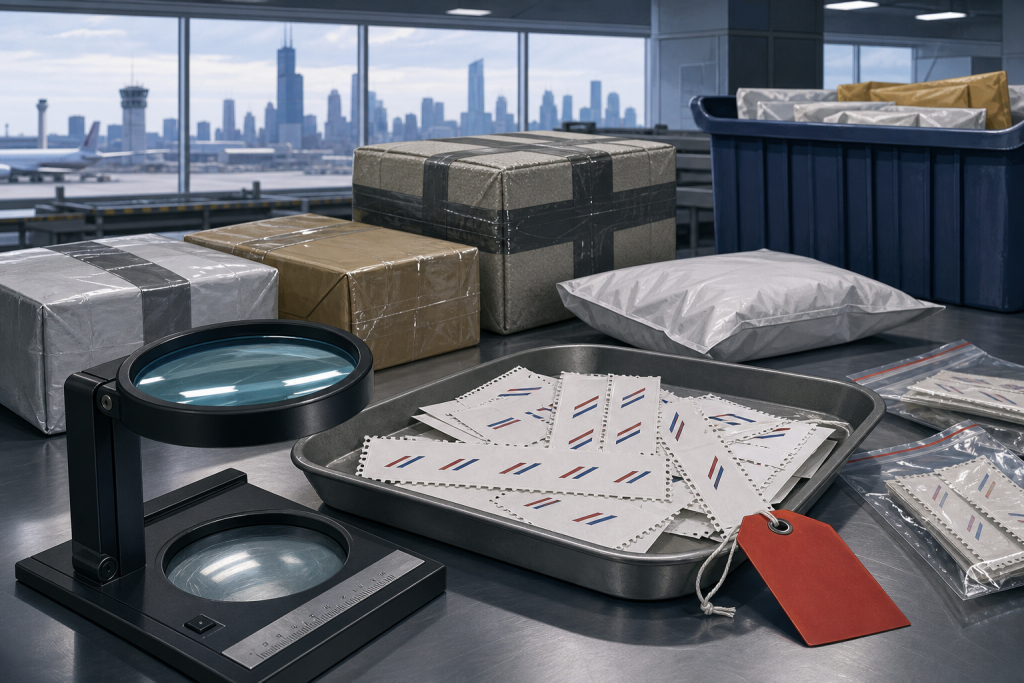
CBP reported two major counterfeit Forever stamp seizures in February 2025: 161,860 stamps in eight China-origin shipments at Chicago’s International Mail Branch, and 200,000 stamps from Hong Kong at the Port of Birmingham. The Chicago stamps would have had a face value above $118,000 if genuine; CBP valued the Birmingham shipment at $146,000. These cases document distribution patterns and enforcement signals, but they do not let a consumer authenticate one stamp from a photo.
CBP Forever Stamp Seizures at a Glance
| CBP release | Location | Quantity | Shipment facts | Reported value if genuine |
|---|---|---|---|---|
| February 13, 2025 | Chicago International Mail Branch | 161,860 | Eight parcels arriving from China | More than $118,000 |
| February 21, 2025 | Port of Birmingham, Alabama | 200,000 | Two inspected packages from Hong Kong | $146,000 |
The figures above are reported case quantities, not an estimate of every counterfeit stamp in circulation. They also should not be added to unrelated CBP seizures as though they measure the full market.
What Happened in Chicago
CBP’s Anti-Terrorism Contraband Enforcement Team stopped eight shipments during the weekend before the February 13 release. All arrived from China. According to CBP, officers relied on the very low invoice value, the routing and efforts to conceal the contents when determining that the stamps were counterfeit. CBP also said the seized print quality was poor while warning that counterfeit quality was improving.
The timing mattered: the agency reported increased counterfeit-postage activity around holidays with heavy card-mailing volume, including Valentine’s Day. That does not mean a holiday design or an imported parcel is automatically counterfeit; it identifies a documented enforcement pattern.
What Happened in Birmingham
Eight days later, CBP reported a separate operation at a local sorting facility connected to the Port of Birmingham. Officers selected two packages for inspection. The contents initially looked authentic, but closer examination led CBP to deem the stamps counterfeit and in violation of intellectual-property laws. The shipment came from Hong Kong.
The Birmingham release also placed the case in a broader enforcement context: China and Hong Kong accounted for about 90% of the total quantity in CBP intellectual-property seizures during fiscal year 2024. That statistic covers counterfeit goods generally, not only postage stamps.
What the Cases Reveal About Distribution
- Bulk movement: both cases involved very large quantities divided among a small number of parcels.
- Cross-border routing: the reported origins were China and Hong Kong.
- Value mismatch: unusually low declared or invoice value was one signal in the Chicago case.
- Improving appearance: a package can look plausible at first glance, so appearance alone is not a reliable certificate of authenticity.
What Consumers Can—and Cannot—Check
Use a layered review: examine the seller and payment trail, compare the price with current face value, retain the packaging and listing, and look for inconsistent printing or packaging. No single warning sign proves that one physical stamp is fake. Our Forever stamp authenticity guide explains the full transaction, product, use and reporting checks.
If you suspect counterfeit postage, do not test it on live mail. Preserve the item and transaction records, then follow the current U.S. Postal Inspection Service reporting instructions. CBP’s cases show why a documented source and accountable seller matter; they do not authorize remote authentication by a retailer or checklist.
Frequently Asked Questions
How many counterfeit Forever stamps did CBP seize in Chicago?
CBP reported 161,860 stamps in eight shipments at the Chicago International Mail Branch in February 2025.
Were the Chicago and Birmingham seizures the same case?
No. CBP published separate releases for different ports, quantities and shipment origins.
Where did the seized shipments originate?
CBP reported China for the Chicago shipments and Hong Kong for the Birmingham shipment.
Does a very low price prove that stamps are counterfeit?
No. It is a risk signal that warrants closer verification, not proof by itself.
Official sources: CBP Chicago release, CBP Birmingham release, and USPIS counterfeit-postage guidance. Facts checked September 1, 2026.