
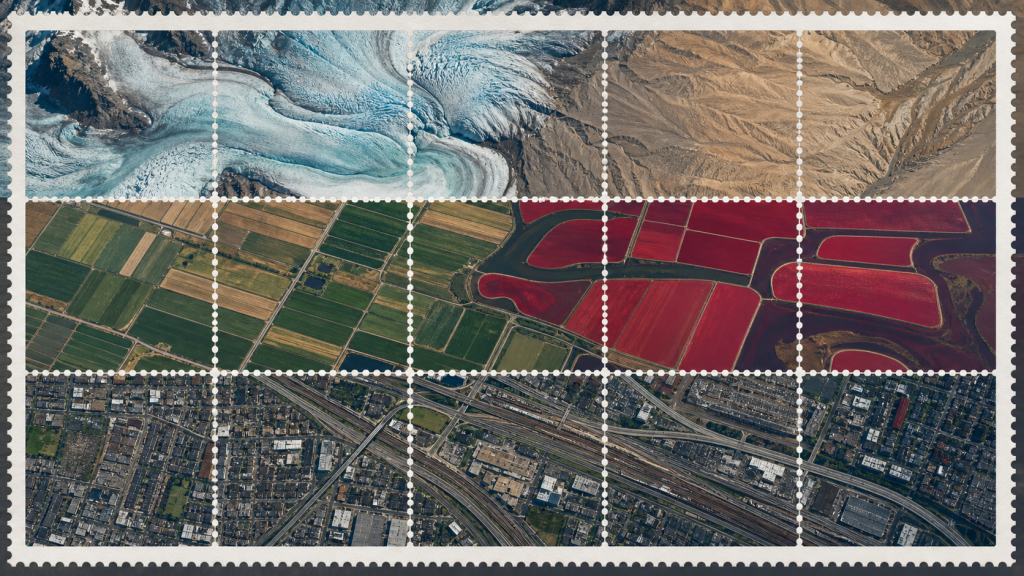
Earthscapes is a 2012 USPS Forever stamp issue with 15 different aerial views arranged in one pane of 15. The top, middle and bottom rows show natural, agricultural and urban landscapes, respectively. USPS issued the pane on October 1, 2012, at NASA’s Goddard Space Flight Center in Greenbelt, Maryland.
Official Earthscapes Issue Facts
| Issue date | October 1, 2012 |
|---|---|
| First-day location | Greenbelt, Maryland, at NASA’s Goddard Space Flight Center |
| Postal class | First-Class Mail Forever; originally priced at 45 cents |
| Original format | Pressure-sensitive pane of 15 |
| Design count | 15 |
| Design structure | 5 natural, 5 agricultural and 5 urban views |
| Art director | Howard E. Paine |
The 15 Designs by Row
| Row | Five subjects |
|---|---|
| Natural | Glacier and icebergs; volcanic crater; geothermal spring; butte in early-morning fog; inland marsh |
| Agricultural | Salt evaporation ponds; log rafts headed to a sawmill; center-pivot irrigation; cherry orchard; cranberry harvest |
| Urban | Residential subdivision; barge fleeting; railroad roundhouse; skyscraper apartments; highway interchange |
The sequence is part of the pane’s meaning. It moves from landscapes shaped largely by natural processes to working landscapes and then to dense human-built patterns. A loose single shows one photograph; a complete pane preserves the three-part comparison.
How the Images Were Made
USPS selected photographs made high above Earth’s surface. Some were captured by satellites—“eyes in the sky”—and others were carefully composed from aircraft. From that height, familiar places become studies in color, texture, repetition and scale.
The NASA Goddard first-day location reinforces the issue’s observation theme, but the pane is not limited to satellite imagery or to NASA subjects. It combines multiple photographers and image-making methods.
How to Identify a Complete Pane
- Confirm a 15-stamp pane arranged in three rows of five.
- Look for the Natural, Agricultural and Urban group structure.
- Verify that each of the 15 subjects appears once.
- Distinguish a complete pane from a single, partial pane, first-day cover or reproduction.
- For collectible condition, inspect perforations, surface, adhesive and selvage without bending the pane.
Are Earthscapes Forever Stamps Still Valid?
Yes. Genuine, unused Earthscapes stamps remain valid as ordinary Forever postage at the current one-ounce First-Class Mail letter-rate value. Their original 45-cent selling price does not limit their present postage value. A finished letter may still need additional postage because of weight, dimensions, rigidity, destination or added service.
Collecting and Buying Notes
A complete pane has a stronger identity than a random single because it preserves all 15 views and their three-row organization. When comparing offers, verify format, completeness, condition and whether any cancellation is present. Postal validity does not guarantee a collectible premium; market value requires comparable sales for the same format and condition.
For another environment-related issue, see the 2020 Earth Day Forever stamps. Browse other subjects through the stamp category directory or review Forever stamp history.
Frequently Asked Questions
How many Earthscapes stamp designs are there?
Fifteen designs, arranged as five natural, five agricultural and five urban views.
How many stamps are in the original pane?
Fifteen—one of each design.
Were all the photographs taken by satellites?
No. USPS says the images were made from satellites or from aircraft.
Can 2012 Earthscapes stamps still be mailed?
Yes, if genuine, unused and intact. Each remains ordinary Forever postage.
Official source: the USPS Earthscapes publicity kit and Stamp Announcement 12-48. Issue facts checked September 1, 2026.
Explore related landscape, wildlife, and outdoor designs in Nature Forever Stamps: Trees, Mountains & Rivers.