
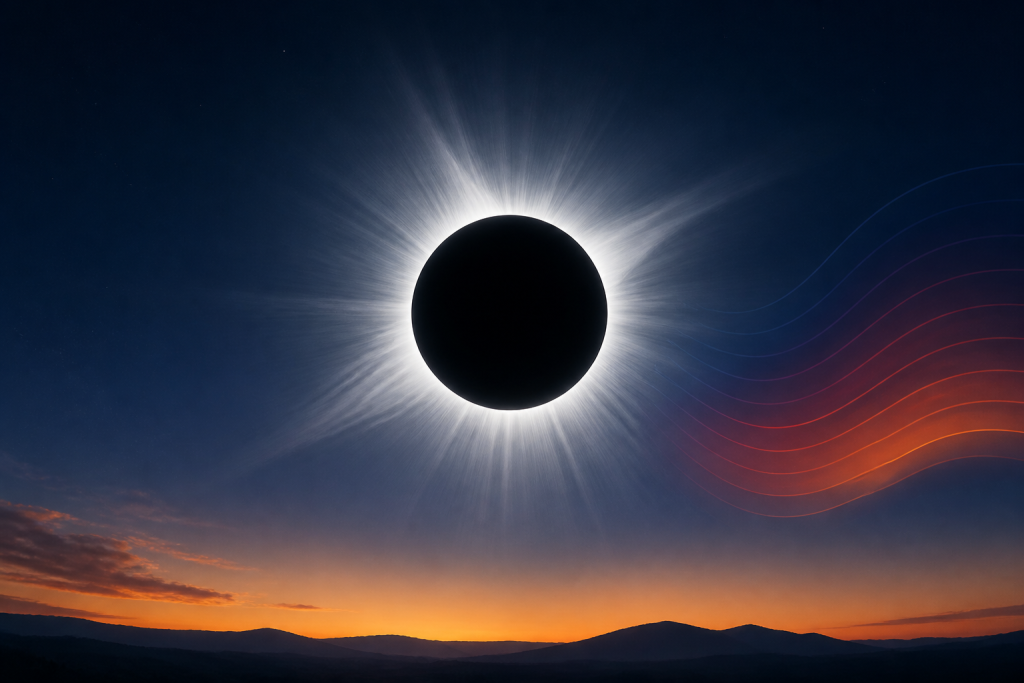
Direct answer: Yes. The 2017 Total Eclipse of the Sun stamp is an ordinary First-Class Mail Forever stamp. An unused, valid example can still pay the current one-ounce domestic letter rate; its 2017 issue price does not limit its postal value.
2017 Total Eclipse Stamp at a Glance
| Official issue | Total Eclipse of the Sun |
|---|---|
| Issue date and place | June 20, 2017, Laramie, Wyoming |
| Postage class | First-Class Mail Forever |
| Original format | One design in a pane of 16; USPS item 475300 |
| Issue price | 49 cents per stamp in 2017 |
| Special feature | Thermochromic ink reveals the Moon when warmed |
| Photographer | Astrophysicist Fred Espenak |
| Designer and art director | Antonio Alcalá |
How the Heat-Reactive Design Works
The printed image shows the dark Moon covering the Sun during a total solar eclipse. Warming the black disc with a fingertip temporarily reveals a second image of the Full Moon underneath. As the stamp cools, the eclipse image returns.
The effect is a design feature, not a test of postal validity. An older stamp may react more slowly or show little visible change after exposure to heat, light, or unsuitable storage. USPS warned that ultraviolet light can damage the thermochromic effect, so collectors should keep panes away from direct sunlight.
What the Images Show
The eclipse photograph was made by Fred Espenak in Jalu, Libya, on March 29, 2006. The hidden Full Moon image was also supplied by Espenak. The back of the pane includes a map tracing the August 21, 2017 eclipse path across the United States.
Is the Stamp Still Valid?
Yes, provided it is genuine, unused, undamaged, and not already canceled. Because it was issued as an ordinary Forever stamp, it remains valid for the current one-ounce First-Class Mail letter rate. Extra weight, nonmachinable characteristics, or another mail class can require additional postage.
Postal value and collector value are different. The Forever designation establishes mailing value, while any collector premium depends on condition, format, demand, and verifiable market evidence. A weak heat-changing effect does not by itself determine whether an unused stamp can be used for postage.
How to Verify a Listing Before Buying
- Confirm the listing identifies the 2017 Total Eclipse of the Sun issue.
- Compare the quantity with the original pane of 16 instead of assuming every seller bundle is an original USPS pane.
- Look for clear front and back photographs, seller identity, return terms, and a traceable payment method.
- Treat unusually large discounts or unsupported collector-value claims as reasons to verify more carefully.
SaleForeverStamps does not currently list this exact issue. For its place in the year’s program, see the complete 2017 Forever stamp directory.
Frequently Asked Questions
Are Total Eclipse stamps Forever stamps?
Yes. USPS issued them as ordinary First-Class Mail Forever stamps in 2017.
How many stamps were in the original pane?
The original USPS pane contained 16 stamps. A seller’s later bundle may contain a different quantity and should be described separately.
Why does the Moon appear when the stamp is touched?
Thermochromic ink responds to finger heat and temporarily reveals the underlying Full Moon image.
Does the heat-changing feature expire?
The visual response can weaken with age or poor storage, especially ultraviolet exposure. That effect is separate from the postal validity of an otherwise genuine, unused stamp.
Sources: USPS issue announcement; USPS Postal Bulletin issue details; USPS technical update. Issue facts checked September 1, 2026.
Explore more astronomy and space-related issues in NASA and Space Forever Stamps: Issue Guide.