
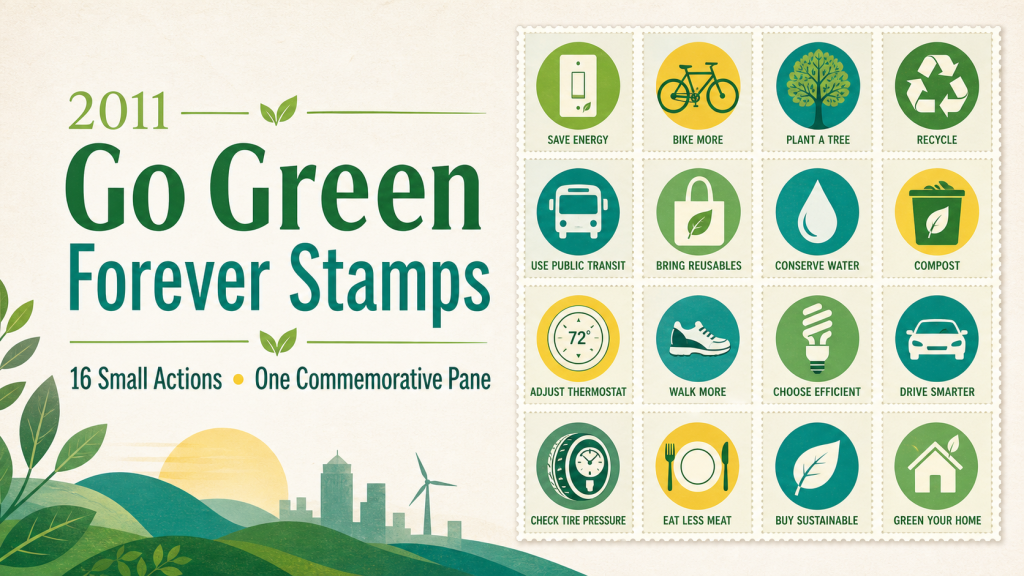
Go Green is a 2011 USPS social-awareness issue containing 16 different Forever stamp designs in one pane of 16. Fifteen designs illustrate practical conservation actions; the sixteenth is the central “Go Green” message about reducing environmental impact step by step.
All 16 Go Green designs
| # | Message on the design | Everyday action |
|---|---|---|
| 1 | Buy local produce, reuse bags | Combine shopping choices with reusable carrying bags |
| 2 | Fix water leaks | Repair unnecessary water loss |
| 3 | Share rides | Reduce single-occupant trips when practical |
| 4 | Turn off lights not in use | Avoid unnecessary electricity use |
| 5 | Choose to walk | Walk for suitable short trips |
| 6 | Go Green—reduce our environmental footprint step by step | Central theme of the pane |
| 7 | Compost | Divert suitable organic material |
| 8 | Let nature do the work | Use natural processes where appropriate |
| 9 | Recycle more | Follow local recycling rules |
| 10 | Ride a bike | Use cycling for suitable journeys |
| 11 | Plant trees | Add and care for trees in appropriate places |
| 12 | Insulate the home | Reduce avoidable heating and cooling loss |
| 13 | Use public transportation | Choose shared transit when available |
| 14 | Use efficient light bulbs | Select lower-energy lighting |
| 15 | Adjust the thermostat | Manage heating and cooling settings |
| 16 | Maintain tire pressure | Keep vehicle tires properly maintained |
These are the messages USPS presented in 2011. They are best read as a period social-awareness campaign, not as a current calculation of the environmental impact of any one action.
Artwork and pane structure
Artist Eli Noyes used colorful, playful illustrations showing different ages and everyday situations. Derry Noyes designed and art-directed the pane. Because every stamp carries a different message, an intact pane provides the complete visual sequence; loose stamps represent only individual actions.
Official issue details
| Issue date | April 14, 2011 |
|---|---|
| First-day city | Washington, D.C. |
| USPS item number | 467000 |
| Postage | First-Class Forever Commemorative |
| Format | Pane of 16 |
| Designs | 16 |
| Artist | Eli Noyes |
| Designer and art director | Derry Noyes |
| Printer | Avery Dennison |
| Manufacturing process | Gravure |
Are 2011 Go Green stamps still valid?
Yes. Genuine, unused Go Green Forever stamps remain valid for the current one-ounce First-Class Mail letter rate even though each stamp originally sold for 44 cents. A heavier, square, rigid, oversized or international mailpiece can require additional postage.
Complete pane or individual stamp?
| Your goal | What to look for |
|---|---|
| Use for ordinary mail | Genuine unused stamps in sound condition; a complete pane is not required |
| Show all campaign messages | An intact 16-design pane |
| Collect one particular action | The exact design, unused or canceled according to your collection |
| Buy a complete issue | All 16 messages and intact surrounding pane elements |
Identification checklist
- Confirm the 2011 date and Go Green issue name.
- Expect 16 unique designs in a complete pane rather than repeats of one image.
- Compare the action wording and pane arrangement with the USPS announcement.
- Separate unused postage value from collector condition and cancellations.
- Keep unused stamps flat, dry and away from heat.
Frequently asked questions
How many Go Green Forever stamps are in a full pane?
Sixteen stamps, with sixteen different designs.
Are all 16 designs separate environmental tips?
Fifteen illustrate specific actions; one central design carries the broader Go Green message.
Does using an old Go Green stamp require extra postage?
Not for an eligible one-ounce domestic First-Class Mail letter. Extra postage depends on the finished mailpiece, not the 2011 issue date.
Looking for a color theme rather than this environmental campaign? Compare green Forever stamp designs across botanical, holiday, landscape and international issues.
Official sources
See USPS Stamp Announcement 11-20 and the official Go Green publicity kit. For the wider year, use the 2011 USPS Forever stamp directory.
Issue details checked September 1, 2026.